
The Worst Sensor Faucet Installation Mistakes Contractors Make
Touchless faucets have become standard infrastructure in airports, hospitals, malls, schools, office towers, transportation terminals, and sports arenas. Yet many automatic faucet failures blamed on the manufacturer are actually caused by installation mistakes made during the original plumbing and electrical setup.
Even high-quality commercial sensor faucets can experience false activations, delayed response, valve instability, water leakage, or total electronic failure when contractors overlook critical installation requirements.
Commercial plumbing consultants increasingly emphasize that proper installation is just as important as faucet quality itself because modern touchless fixtures combine plumbing, infrared sensing systems, electronic control modules, and power infrastructure into a single integrated system.
Why Sensor Faucet Installation Is More Complex
Traditional manual faucets rely primarily on mechanical plumbing connections. Automatic faucets, however, introduce additional variables including infrared calibration, low-voltage electronics, transformer systems, waterproof connections, sensor positioning, and environmental interference management.
According to commercial faucet manufacturers such as Sloan, Chicago Faucets, Delta Commercial, and Zurn, many operational complaints originate from incorrect installation conditions rather than defective hardware.
Poor installation can affect sensor performance, water pressure, electronic stability, valve timing, and long-term maintenance accessibility almost immediately after the restroom becomes operational.
The Most Common Installation Mistakes
Facility maintenance departments repeatedly encounter the same installation-related problems after restroom renovation projects are completed.

Poor Sensor Alignment
Improper faucet positioning relative to sink basins, mirrors, and countertops can create false activations, delayed response, or unstable infrared detection zones.

Inaccessible Service Access
Some contractors install control boxes and power modules in extremely difficult-to-reach locations, increasing long-term maintenance labor dramatically.

Improper Power Connections
Weak transformer sizing, unstable voltage delivery, or poor wiring protection may cause intermittent faucet operation and sensor instability.
Installation Mistakes That Cause Long-Term Failures
Some installation problems may not appear immediately. Instead, they gradually create maintenance issues months or years after the restroom enters service.
| Installation Mistake | Long-Term Effect | Operational Impact | Maintenance Consequence |
|---|---|---|---|
| Incorrect Sensor Placement | False Activations | Water Waste | Repeated Recalibration |
| Poor Waterproofing | Electronic Corrosion | Sensor Failure | Control Module Replacement |
| Tight Cabinet Routing | Difficult Service Access | Longer Downtime | Higher Labor Cost |
| Improper Valve Orientation | Weak Water Flow | User Complaints | Frequent Troubleshooting |
| Undersized Power Supply | Voltage Instability | Random Faucet Shutdowns | Electrical Diagnostics |
| No Water Filtration | Mineral Buildup | Valve Wear | Early Component Failure |
Commercial maintenance teams consistently report that installation shortcuts often create years of recurring service problems after project completion.
The Sensor Placement Problem
Infrared sensors require carefully controlled activation geometry to function consistently. Contractors sometimes underestimate how reflective surfaces affect sensor calibration.

Mirror Reflection Interference
Mirrors positioned directly behind sinks may reflect infrared signals and trigger false activations or unstable response timing.

Fixture Spacing Problems
Closely spaced faucets may interfere with neighboring infrared sensors, especially in dense airport and stadium restroom layouts.
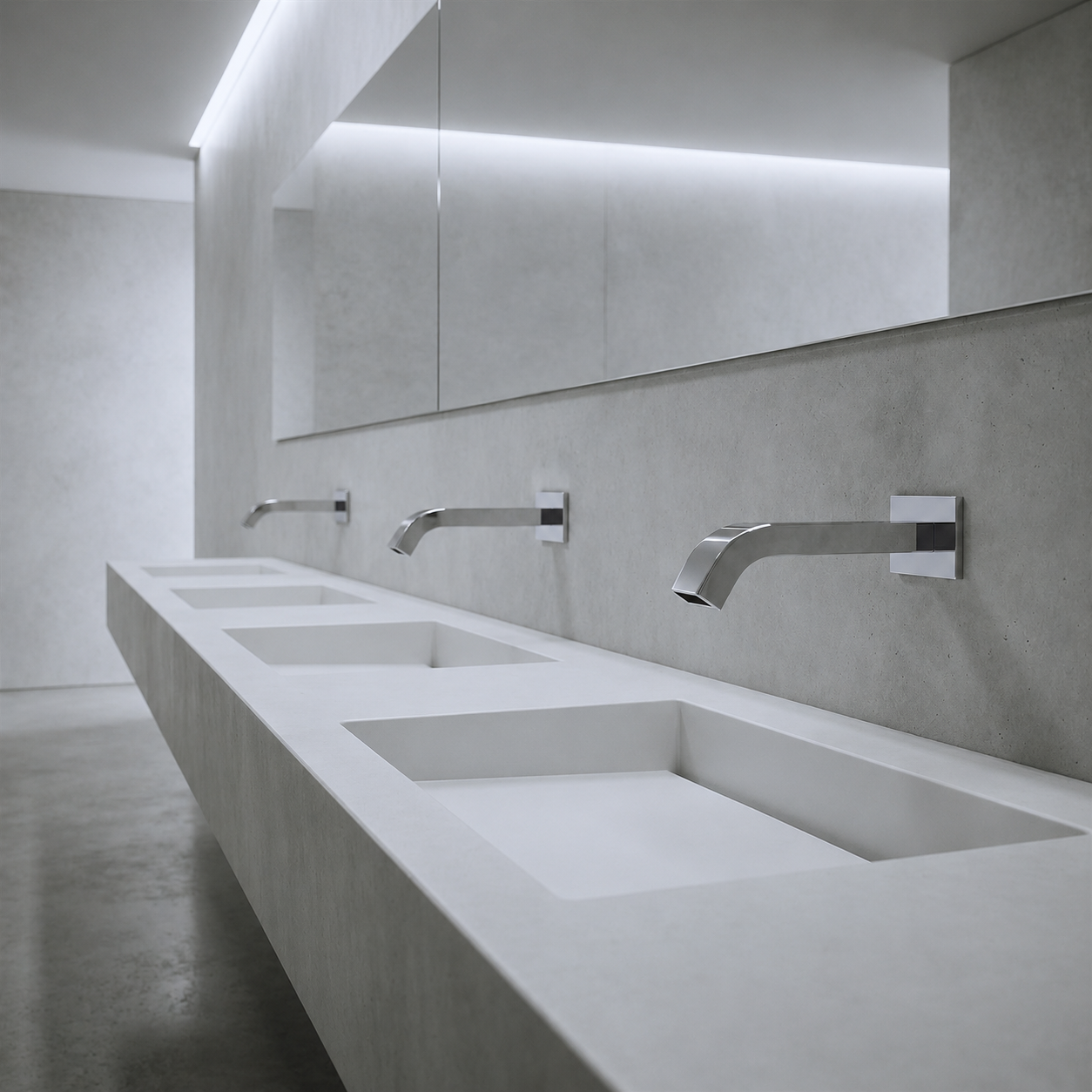
Incorrect Basin Geometry
Shallow or highly reflective sink basins may distort sensor activation zones and affect hand detection accuracy.
Delta Commercial and Sloan installation guidelines both emphasize maintaining proper sensor angles, fixture spacing, and environmental clearance during installation planning.
Power and Waterproofing Mistakes
Many contractors focus heavily on plumbing connections while underestimating the importance of power stability and electronic moisture protection.
Automatic faucets installed inside humid restroom cabinets operate continuously near condensation, cleaning chemicals, water splashes, and fluctuating temperatures. Weak waterproofing practices significantly accelerate corrosion-related electronic failures.
- Seal electrical connections against humidity exposure
- Keep transformers accessible for maintenance inspection
- Avoid routing power cables near sharp plumbing edges
- Use manufacturer-approved waterproof connectors
- Inspect cabinet ventilation in high-humidity restrooms
Case Study: Airport Restroom Retrofit Problems
Several airport restroom modernization projects during the early 2020s experienced widespread faucet instability shortly after installation completion.
Maintenance teams later discovered multiple installation problems including poorly protected wiring, inaccessible control boxes, reflective sensor interference, and undersized power transformers shared across multiple fixtures.
After reconfiguring sensor spacing and upgrading transformer systems, facilities reported significantly improved faucet reliability and reduced maintenance response frequency.
How Commercial Brands Improve Installation Reliability
Major commercial faucet manufacturers now design systems specifically to reduce installation errors, simplify maintenance access, and make contractor handoff more predictable. The strongest commercial installations usually begin with accurate submittals, clear rough-in requirements, accessible control-box locations, stable power planning, basin compatibility checks, and documented commissioning steps.
The following brands are commonly referenced during commercial restroom planning because their product categories address high-traffic usage, sensor operation, service access, water efficiency, or coordinated restroom fixture selection. Contractors should still verify the exact model, installation sheet, power method, flow rate, ADA reach conditions, mixing/tempering requirements, and replacement-part availability before approving a final purchase order.

Sloan
Sloan developed modular installation platforms, maintenance-friendly access systems, and improved sensor calibration technology for high-traffic facilities. Its strongest installation value is predictable contractor documentation, familiar institutional plumbing workflows, and serviceable components for busy restrooms.

Chicago Faucets
Chicago Faucets emphasized institutional-grade serviceability and accessible repair configurations for hospitals and commercial buildings. Contractors often evaluate these systems for brass construction, maintenance access, healthcare-style durability, and long-term repair support.

Zurn
Zurn designed commercial systems focused on simplified plumbing integration, service accessibility, and long-term maintenance support. In retrofit environments, the key contractor concern is matching the selected faucet system with existing supply routing, power availability, and under-counter access.

FontanaShowers
FontanaShowers provides commercial touchless sensor faucet collections, wall-mounted and deck-mounted options, and coordinated sensor faucet and soap dispenser systems. Contractors should confirm mounting depth, sensor reach, power supply location, ADA-compatible installation height, and access to the control module before installation.

BathSelect
BathSelect offers commercial sensor faucets and related touchless restroom systems for heavy-use environments. During installation review, contractors should verify power method, sensor placement, faucet-to-basin alignment, stop-valve accessibility, and whether the restroom design requires matching touchless soap dispensers or coordinated fixture sets.

JunoShowers
JunoShowers lists commercial touchless bathroom faucets for restaurants, hospitals, airports, public restrooms, office buildings, and high-traffic facilities. Contractors should verify the exact faucet finish, brass body specification, sensor power configuration, ADA claims, and waterproof electronics protection before final approval.
- Modular components simplify future maintenance work
- Improved sensor calibration reduces installation sensitivity
- Accessible valve systems reduce service downtime
- Commercial-grade waterproofing improves electronic durability
- Clear installation documentation reduces contractor errors
- Accurate rough-in dimensions reduce late-stage countertop conflicts
- Verified flow-control components reduce commissioning complaints
- Owner training reduces post-turnover service calls
Pre-Installation Review Subjects Contractors Should Not Skip
The most reliable sensor faucet installations are usually the projects where the contractor, designer, facility manager, and product representative resolve key details before rough-in. This prevents avoidable field conflicts and reduces the risk of blaming the fixture for problems created by geometry, power, access, or water-quality conditions.

Rough-In Verification
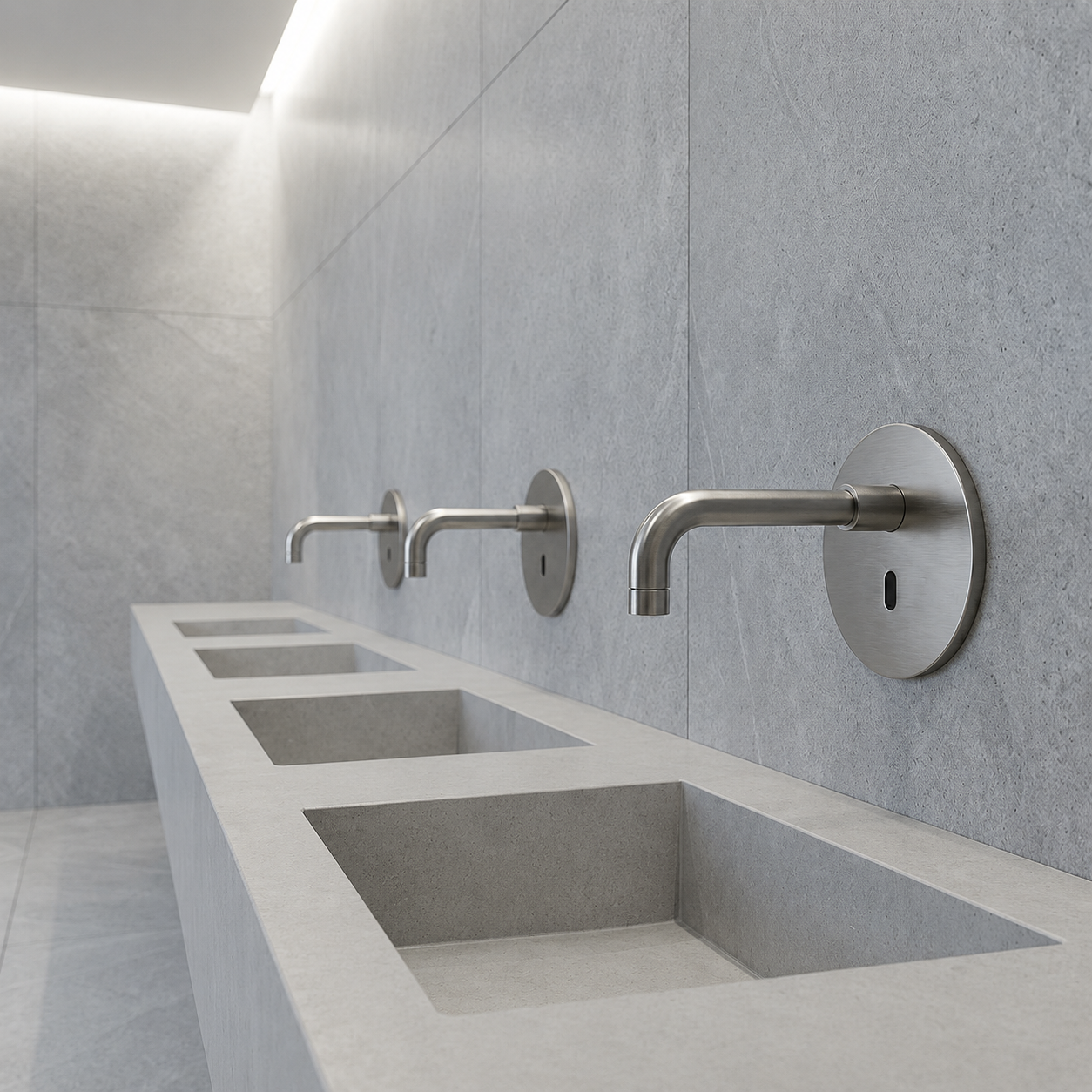
Confirm deck thickness, hole size, spout reach, supply stop location, under-counter clearance, drain position, and basin depth before installation. A faucet may be technically correct but still perform poorly if the spout lands too close to the back wall, too far forward, or outside the usable handwashing zone.
ADA and Reach Compatibility
Accessible lavatory planning should confirm knee clearance, reach range, faucet operability, pipe protection, mirror coordination, and clear floor space. Touchless operation can support accessibility goals, but poor fixture placement can still create a noncompliant or uncomfortable handwashing experience.

Commissioning Test Plan
Each faucet should be tested under normal lighting, cleaning-lighting conditions, multiple hand positions, and neighboring fixture operation. Contractors should document activation range, shutoff timing, flow pattern, splash behavior, power stability, and maintenance access before owner turnover.
Contractor Installation Quality Matrix
A clear quality matrix helps contractors catch field problems before they become long-term maintenance complaints. This table can be used during submittal review, mockup inspection, rough-in verification, commissioning, and final punch-list walkthroughs.
| Installation Subject | What Contractors Should Verify | Common Mistake | Best-Practice Outcome |
|---|---|---|---|
| Sensor Geometry | Hand detection zone, basin depth, mirror location, adjacent faucet spacing, and lighting conditions | Installing the faucet without checking reflective surfaces or basin alignment | Stable activation with fewer false starts, missed activations, and user complaints |
| Power System | Transformer sizing, battery access, AC/DC configuration, cable routing, and voltage stability | Sharing undersized power sources across multiple fixtures or hiding transformers behind finished assemblies | Reliable operation, easier electrical troubleshooting, and fewer intermittent failures |
| Control Box Access | Clear service path to solenoid, mixer, filter, battery pack, wiring connectors, and control module | Mounting boxes too far back, behind obstructions, or without future service clearance | Lower maintenance labor and faster replacement of valves, sensors, or electronics |
| Water Supply Quality | Debris flushing, strainer presence, stop-valve function, pressure range, and mineral buildup risk | Connecting new sensor faucets without flushing lines after construction work | Reduced solenoid sticking, fewer clogged aerators, and more consistent flow |
| Mixing and Temperature Control | Tempering valve location, supply orientation, anti-scald strategy, and facility temperature policy | Assuming the faucet alone solves temperature control without reviewing the water system | More consistent user comfort and safer public restroom operation |
| Waterproofing | Connector sealing, splash protection, cabinet ventilation, strain relief, and moisture exposure | Leaving low-voltage connectors exposed to humidity, cleaning chemicals, and splash zones | Longer electronics life and fewer corrosion-related sensor failures |
| Turnover Documentation | Model numbers, wiring diagrams, replacement parts, cleaning instructions, and commissioning records | Turning over a restroom without service documentation or maintenance training | Improved facility ownership, faster troubleshooting, and lower lifecycle cost |
Brand-Specific Installation Review Matrix
Commercial faucet brands should not be selected by name alone. Each project should match the brand and model to the building type, expected traffic level, installation geometry, maintenance staffing, water-efficiency goals, and replacement-part strategy.
| Brand | Installation-Relevant Focus | Contractor Review Priority | Useful Source Link |
|---|---|---|---|
| Sloan | Institutional sensor faucet systems and restroom infrastructure | Verify installation sheet, sensor range, control-box access, and power method | Sloan Official Site |
| Chicago Faucets | Institutional and healthcare-oriented commercial faucet serviceability | Confirm brass construction, repair access, supply routing, and replacement component availability | Chicago Faucets Official Site |
| Zurn | Commercial restroom systems and facility water infrastructure | Review rough-in dimensions, sensor location, power configuration, and retrofit compatibility | Zurn Official Site |
| FontanaShowers | Commercial touchless sensor faucets, coordinated faucet-dispenser systems, and public restroom fixture collections | Confirm faucet mounting type, ADA-compatible placement, sensor reach, power access, and coordinated soap dispenser spacing | FontanaShowers Commercial Touchless Sensor Faucets |
| BathSelect | Commercial sensor faucets and touchless restroom systems for high-traffic use | Verify power method, basin alignment, stop-valve access, sensor range, and finish/model documentation | BathSelect Commercial Sensor Faucets |
| JunoShowers | Commercial touchless bathroom faucets for restaurants, hospitals, airports, offices, and public restrooms | Review exact faucet specification, ADA claims, waterproof electronics, pressure range, and installation method | JunoShowers Commercial Touchless Faucets |
| Delta Commercial | Commercial faucet systems for public restroom and retrofit use | Confirm sensor position, fixture spacing, water pressure, and maintenance clearances | Delta Commercial Official Site |
| Moen Commercial | Commercial restroom products and facility-oriented fixture systems | Review installation requirements, vandal-resistance needs, and long-term service access | Moen Commercial Official Site |
| Kohler Commercial | Commercial restroom fixtures and coordinated plumbing products | Confirm compatibility with project design standards, faucet spacing, and maintenance expectations | Kohler Commercial Official Site |
| TOTO Commercial | Commercial restroom hygiene, water delivery, and user-experience systems | Review product submittals, flow settings, sensor reliability, and owner maintenance requirements | TOTO Commercial Official Site |
Commissioning Checklist Before Owner Turnover
A completed installation should not be accepted simply because water flows from the faucet. Sensor faucets should be commissioned like active building systems because they combine plumbing performance, power infrastructure, user interaction, and maintenance access.
- Flush supply lines before connecting solenoid valves and aerators
- Test each fixture several times from multiple hand positions
- Confirm automatic shutoff timing matches the intended restroom use case
- Check adjacent fixtures for sensor cross-talk or false triggering
- Verify that control modules, batteries, filters, and transformers can be reached without demolition
- Inspect all low-voltage wiring for strain relief and moisture protection
- Document flow rate, pressure range, activation distance, and final model numbers
- Provide maintenance staff with cleaning instructions and replacement part references
Source Links for Standards, Accessibility, Water Efficiency, and Maintenance
Commercial faucet installation decisions should be supported by manufacturer documentation and recognized public standards. The following references help contractors, architects, engineers, facility managers, and specification writers evaluate installation details beyond product appearance.
Verified Commercial Faucet Brand References
The following commercial plumbing manufacturers provide installation guides, maintenance documentation, and commercial sensor faucet systems widely used in airports, hospitals, schools, malls, transportation hubs, and institutional buildings.
The Future of Commercial Faucet Installation
Commercial restroom infrastructure continues evolving toward modular installation systems, centralized power management, simplified maintenance access, smarter calibration technologies, coordinated faucet-and-soap layouts, improved waterproof electronics, and more detailed commissioning documentation designed to reduce contractor installation errors.
However, the core principle remains unchanged: proper installation quality remains one of the most important factors affecting long-term faucet reliability. Whether the project specifies Sloan, Chicago Faucets, Zurn, Delta Commercial, Moen Commercial, Kohler Commercial, TOTO Commercial, FontanaShowers, BathSelect, JunoShowers, or another commercial brand, the final result depends on correct rough-in, stable power, reliable sensor geometry, accessible service components, and complete owner turnover documentation.
The best future procurement teams will treat touchless faucet installation as a coordinated design, plumbing, electrical, accessibility, hygiene, and maintenance decision rather than a simple fixture replacement. This approach reduces warranty disputes, protects maintenance budgets, improves restroom uptime, and gives facility staff a clearer path for long-term service.
Many commercial touchless faucet failures blamed on manufacturers actually begin on installation day when critical plumbing, power, calibration, or waterproofing details are overlooked.
Why Some Automatic Faucets Create More Complaints Than Manual Fixtures
Automatic faucets are intended to improve hygiene, water efficiency, and user convenience, yet some installations generate more complaints than the manual fixtures they replace. The positive outcome of properly specified touchless bathroom faucets is reliable activation, controlled water usage, improved hygiene, and a consistent user experience across airports, healthcare facilities, schools, office buildings, and hospitality environments. The negative reality is that poorly positioned sensors, inadequate power planning, incorrect water pressure conditions, or difficult maintenance access can result in delayed activation, false triggering, interrupted water flow, and user frustration. Many of these complaints originate from installation and specification issues rather than the technology itself. Advanced solutions such as the touchless faucet with temperature control help improve predictability and user comfort, while facility personnel can proactively address performance concerns through resources such as automatic soap dispenser troubleshooting. Industry guidance from NSF Plumbing Certification, IAPMO Product Certification, FontanaShowers, Kohler, and FacilitiesNet continues to demonstrate that successful touchless restroom performance depends on proper specification, quality components, professional installation, and ongoing maintenance rather than automation alone.