
What Makes a Commercial Sensor Faucet Truly Durable?
Modern commercial restrooms depend heavily on touchless faucet systems to maintain hygiene, reduce water waste, and support continuous public use. Yet not every automatic faucet is engineered to survive the extreme demands of airports, hospitals, malls, universities, office towers, transportation hubs, restaurants, and sports arenas.
While many faucets may appear visually identical on the outside, the true difference between short-lived fixtures and long-lasting commercial systems is hidden inside the engineering — within the valve assemblies, electronic protection, sensor calibration systems, brass construction quality, mounting hardware, aerator control, power architecture, and long-term serviceability design.
This guide explains how facility managers, architects, specifiers, plumbing engineers, and owners can evaluate commercial sensor faucet durability beyond surface appearance, marketing claims, and initial fixture price.
Why Durability Matters in Commercial Restrooms
Unlike residential bathrooms, public restrooms experience nonstop operational stress. Faucets inside airports, transportation hubs, schools, hospitals, stadiums, universities, and entertainment venues may activate tens of thousands of times every month. Every activation cycle places mechanical and electronic stress on the valve assembly, infrared sensors, seals, wiring systems, aerators, power supply, and control modules.
Durability failures create more than simple repair costs. They increase restroom downtime, water waste, maintenance labor, sanitation complaints, guest dissatisfaction, ADA accessibility interruptions, and operational disruption. A failed faucet in a single-user office restroom is inconvenient; a failed faucet bank in a high-volume airport concourse can affect passenger flow, cleaning schedules, and public perception.
The U.S. Environmental Protection Agency’s WaterSense program emphasizes that labeled products must combine water efficiency with performance, making long-term fixture reliability an important part of responsible restroom planning. EPA WaterSense Product Specifications
What “Durable” Really Means for a Sensor Faucet
Durability is often misunderstood as weight, finish thickness, or brand reputation alone. In commercial restroom engineering, durability is better measured by lifecycle behavior: how consistently the faucet activates, shuts off, resists leaks, survives cleaning chemicals, tolerates vandalism, protects electronics, maintains flow performance, and allows maintenance staff to replace parts without dismantling the restroom.
A truly durable sensor faucet should support predictable use under changing restroom conditions. That includes reflective countertop surfaces, mirror glare, variable lighting, hard water deposits, frequent cleaning, voltage fluctuation, public abuse, accidental impacts, and maintenance by different technicians over many years.
| Durability Area | What Specifiers Should Check | Why It Matters | Common Failure When Ignored |
|---|---|---|---|
| Body Material | Brass construction, corrosion resistance, secure mounting | Protects against cracking, flexing, and vandal stress | Loose fixtures, finish wear, body distortion |
| Valve Assembly | Commercial solenoid, serviceable filter, seal quality | Controls shutoff stability and leak prevention | Dripping, delayed shutoff, stuck-open flow |
| Electronics Protection | Sealed control box, protected wiring, moisture isolation | Prevents humidity and chemical damage | False activation, dead sensor, intermittent operation |
| Sensor Logic | Stable infrared range, timeout setting, anti-ghost activation | Improves user experience and reduces water waste | False triggers, non-detection, repeated complaints |
| Maintenance Access | Modular components, accessible control module, available replacement parts | Reduces labor and downtime | Full fixture replacement for small component failures |
The Core Features of Durable Commercial Faucets
Commercial-grade touchless faucets differ significantly from low-end automatic fixtures because they are built around long-term lifecycle engineering rather than short-term installation cost reduction.

Solid Brass Construction
High-quality commercial faucets typically use heavy brass bodies that resist cracking, corrosion, vandalism, vibration, and structural fatigue far better than thin cast-metal or plastic assemblies. Brass also supports stronger deck mounting and better long-term thread integrity around inlet connections.

Stable Sensor Calibration
Durable sensor systems maintain consistent activation performance even under reflective restroom lighting conditions, heavy usage cycles, glossy countertops, changing daylight, dark finishes, and different user hand positions.

Serviceable Components
Commercial maintenance teams prioritize faucets with modular repair access that allow solenoids, sensors, aerators, power boxes, and control modules to be serviced without replacing the entire fixture.
Material Strength, Finish Quality, and Corrosion Resistance
Body material has a direct effect on commercial durability. Thin bodies can loosen under repeated public use, weaker finishes can stain from cleaning chemicals, and poorly protected internal waterways can create long-term corrosion concerns. For specification work, the faucet body should be evaluated alongside drinking-water material standards, finish wear expectations, and installation conditions.
NSF/ANSI/CAN 61 addresses health-effects requirements for components and materials that contact drinking water, while ASME A112.18.1/CSA B125.1 covers plumbing supply fittings and accessories. These references help specifiers separate surface-level finish descriptions from actual performance and safety expectations. NSF/ANSI 61 | ASME A112.18.1/CSA B125.1

Heavy Body Construction
Stronger faucet bodies resist loosening, side loading, accidental impact, and cleaning-equipment contact. This matters in airports, public schools, stadiums, and transport stations where fixture abuse is common.

Durable Surface Finish
Commercial finishes should tolerate frequent wiping, chemical exposure, mineral spotting, and high-touch cleaning schedules without rapid discoloration or coating breakdown.

Corrosion Control
Corrosion resistance is especially important in coastal properties, healthcare environments, hotel restrooms, pool facilities, and high-humidity public buildings.
Why Valve Systems Matter So Much
The solenoid valve assembly is often considered the heart of a touchless faucet system. Every faucet activation depends on stable valve communication between the sensor module and water delivery mechanism. When the valve is weak, the faucet may drip, fail to open, fail to close, activate slowly, or become vulnerable to mineral buildup.
| Valve Characteristic | Low-Grade Faucet Result | Commercial-Grade Advantage | Operational Impact |
|---|---|---|---|
| Cheap Plastic Components | Early Valve Wear | Commercial Brass Valve Systems | Longer Operational Life |
| Weak Internal Springs | Sticking Water Flow | Heavy-Duty Valve Engineering | Stable Shutoff Control |
| Minimal Filtration | Mineral Buildup | Integrated Service Filters | Reduced Maintenance Frequency |
| Poor Seal Materials | Leak Development | Commercial Rubber Compounds | Improved Water Control |
| Low Cycle Ratings | Premature Failure | High-Cycle Commercial Testing | Extended Lifespan |
| Non-Serviceable Valve Box | Expensive Fixture Replacement | Replaceable Solenoid Cartridge | Lower Lifecycle Cost |
Commercial plumbing consultants consistently report that valve quality is one of the biggest differences between low-cost automatic faucets and durable institutional-grade restroom systems. A reliable valve should close fully, tolerate sediment better, remain accessible for maintenance, and support predictable flow control across many years of service.
Sensor Reliability Under Real Restroom Conditions
Sensor performance is not only about detecting a hand during a product demonstration. In real buildings, sensors must operate beside reflective mirrors, glossy counters, changing daylight, LED lighting, dark clothing, wheelchair users, children, and repeated crowd movement. Poor calibration creates false activations, delayed starts, short run times, long run times, or non-detection complaints.
Durable sensor faucets use detection logic that can remain stable after cleaning, after power interruptions, and after years of public use. Specifiers should review adjustable range, timeout behavior, manual reset procedures, and whether the system supports both hygiene and accessibility goals.
- Stable infrared range reduces false starts from reflective surfaces
- Auto-timeout protection reduces accidental continuous water flow
- Clear commissioning instructions reduce inconsistent setup between faucet banks
- Accessible activation zones help different users operate the faucet without touch
- Sensor modules should be replaceable without removing the faucet body
Why Waterproof Electronics Are Critical
Commercial restrooms expose faucet electronics to constant humidity, condensation, cleaning chemicals, temperature shifts, airborne moisture, splash exposure, and accidental water intrusion from countertop cleaning. Poorly protected control modules eventually corrode internally, leading to unstable activation behavior or total electronic failure.

Moisture Protection
Commercial-grade waterproof sealing protects internal electronics from long-term humidity exposure and cleaning chemical penetration. Protected control boxes are especially important under deck-mounted sinks.

Stable Power Delivery
Reliable power systems prevent sensor instability, delayed activation, and valve communication problems caused by weak batteries, inconsistent adapters, or exposed wiring.

Corrosion Resistance
Advanced electronic protection reduces internal corrosion that commonly destroys lower-grade automatic faucet systems after repeated exposure to water vapor and cleaning chemicals.
Where electric components are used in plumbing equipment, specifiers should also review applicable electrical-plumbing safety references such as UL 1951 for electric plumbing accessories. UL 1951 Electric Plumbing Accessories
Power Architecture: Battery, AC, and Hybrid Systems
Power supply design directly affects durability because weak batteries, inaccessible battery boxes, and inconsistent low-voltage adapters can create the appearance of sensor or valve failure. In large commercial restrooms, power planning should be coordinated early with electrical access, sink deck design, chase access, and maintenance routines.
| Power Type | Best Use Case | Durability Advantage | Maintenance Concern |
|---|---|---|---|
| Battery Powered | Retrofit projects without nearby electrical access | Fast installation and flexible placement | Battery replacement labor across many fixtures |
| AC Powered | New construction, airports, hospitals, universities, stadiums | Stable long-term power and reduced battery checks | Requires coordinated electrical rough-in |
| Hybrid AC/DC | High-traffic buildings needing backup power flexibility | Operational continuity during limited power disruption | More components to document and maintain |
| Plug-In Control Box | Accessible service zones under counters | Easy module replacement | Must be protected from moisture and cleaning damage |
Flow Control, Aerators, and Water Efficiency
Durability and water efficiency are connected. A faucet that saves water during the first month but clogs frequently, drips after valve wear, or causes repeated user complaints will not perform well across its lifecycle. Durable sensor faucets should balance flow rate, handwashing comfort, aerator accessibility, pressure compatibility, and shutoff stability.
WaterSense guidance and federal acquisition resources identify water-efficient plumbing as a major operating-cost strategy for facilities. For commercial buildings, efficiency should be evaluated together with maintenance access, aerator replacement, flow testing, and water pressure management. WaterSense Products | Federal Energy Management Program Water-Efficient Purchasing
- Low-flow aerators should remain comfortable enough for effective handwashing
- Aerators should be accessible for cleaning and replacement
- Flow performance should be confirmed at actual building water pressure
- Supply filters help protect solenoid valves from sediment
- Timeout settings should prevent long accidental run cycles
Maintenance Accessibility and Lifecycle Cost
The most durable commercial faucet is not only the one that fails less often; it is also the one that can be serviced quickly when a component eventually wears. Public restrooms must return to service fast. This makes replacement-part availability, under-deck access, clear wiring, service filters, and modular control boxes critical specification concerns.

Under-Deck Access
Maintenance staff should be able to access shutoff valves, control boxes, filters, and power supplies without removing counters, sink assemblies, or adjacent fixtures.
Replacement Parts
A durable specification includes part numbers for solenoids, sensors, aerators, mixing valves, power supplies, and seals so the facility can repair instead of replace.

Commissioning Checklist
Sensor range, flow rate, timeout setting, hot-water mixing, shutoff behavior, and leak testing should be documented at turnover before high-traffic operation begins.
Case Study: Hospital and Airport Faucet Upgrades
Several hospitals and transportation facilities that originally installed lower-cost touchless fixtures later reported increasing operational failures after years of heavy use. Maintenance teams identified recurring problems involving valve sticking, unstable sensors, battery instability, mineral buildup, finish deterioration, and inaccessible repair systems.
After transitioning to institutional-grade faucet platforms with modular repair components and upgraded waterproof electronics, many facilities reported lower downtime frequency and improved maintenance efficiency. The biggest improvement was not always a new smart feature; it was often the ability to service valves, filters, sensors, and power modules more quickly.
How Leading Commercial Brands Build Durable Systems
Major commercial faucet manufacturers and specialty fixture brands approach durability through different combinations of brass construction, sensor reliability, repair access, finish selection, high-traffic suitability, and coordinated restroom fixture programs. The strongest specification compares not only product appearance, but also lifecycle serviceability and technical documentation.

Sloan
Sloan is widely associated with institutional restroom systems, sensor faucets, flushometers, and commercial plumbing products. For durability-focused projects, Sloan is often considered where maintenance teams want established commercial infrastructure, modular service support, and products intended for high-traffic public facilities.

Chicago Faucets
Chicago Faucets is frequently specified in healthcare, education, institutional, and public-building environments where brass construction, repairability, and long-term maintenance familiarity are major priorities.

Delta Commercial
Delta Commercial combines brand familiarity with commercial faucet platforms, sensor options, and water-management strategies suitable for office, education, hospitality, and institutional restroom projects.

Moen Commercial
Moen Commercial supports public restroom planning through sensor faucets, water-efficient systems, vandal-resistant considerations, and product categories designed for larger facility operations.

Zurn
Zurn is often evaluated for commercial plumbing packages that include sensor faucets, flush valves, drainage, backflow, and broader building water-management products where coordinated infrastructure matters.

TOTO Commercial
TOTO Commercial brings hygiene-focused fixture engineering, sensor technologies, and commercial restroom products often considered in healthcare, hospitality, public washrooms, and institutional design.

FontanaShowers
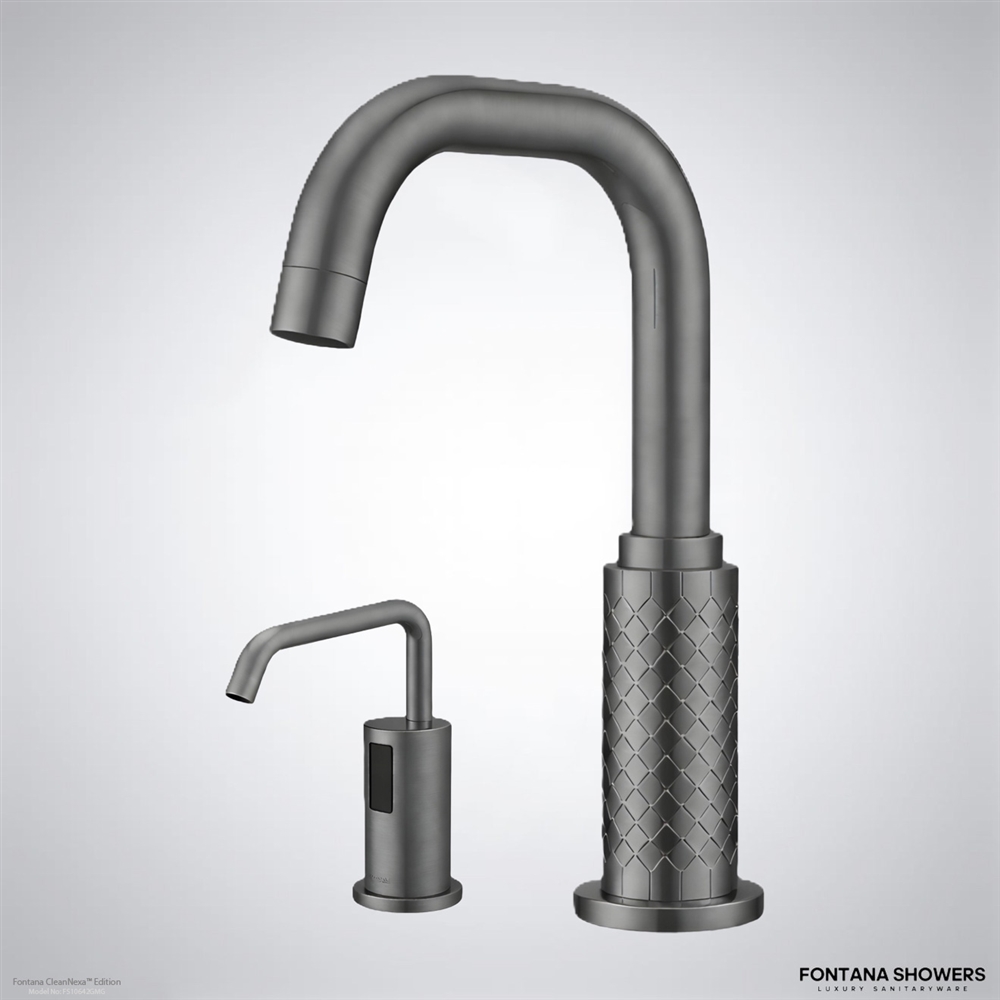
FontanaShowers offers commercial touchless sensor faucet collections, deck-mounted and wall-mounted options, faucet-and-soap-dispenser combinations, ADA-focused selections, and low-flow aerator options for commercial restroom design. It is relevant for projects that need coordinated visual presentation with hands-free operation, hygiene planning, and fixture-package consistency.

BathSelect
BathSelect provides touchless bathroom faucets, automatic soap dispensers, shower systems, and commercial restroom fixture selections. Its value in durability discussions is the ability to coordinate sensor faucets with touchless soap delivery and broader bathroom fixture programs for hospitality, office, and public restroom applications.

JunoShowers
JunoShowers lists touchless bathroom faucet options with motion sensor operation, brass materials, commercial-use descriptions, ADA-compliant product references, and finish variety. It is useful for designers comparing sensor faucet styles, finish coordination, and commercial restroom fixture appearance across multiple project types.
- Heavy-duty brass construction improves structural lifespan
- Commercial valve systems survive high activation cycles
- Waterproof electronics reduce corrosion failure risk
- Stable infrared calibration reduces false activations
- Modular repair systems reduce maintenance downtime
- AC-powered infrastructure improves operational reliability
- Coordinated faucet and soap-dispenser packages can simplify restroom fixture planning
- Documented source links help specifiers verify product claims before procurement
Brand Comparison for Durability-Focused Specifications
The following table is not a ranking. It organizes brand relevance by specification questions that matter in durability-focused commercial restroom work.
| Brand | Useful Specification Focus | Best Fit Project Type | What to Verify Before Selection |
|---|---|---|---|
| Sloan | Institutional touchless plumbing systems and restroom infrastructure | Airports, stadiums, universities, healthcare, transportation | Model-specific repair parts, power type, sensor range, rough-in details |
| Chicago Faucets | Heavy-duty commercial brass fixtures and institutional repairability | Hospitals, schools, laboratories, public buildings | Body material, cartridge/valve service access, finish compatibility |
| Delta Commercial | Commercial sensor faucets and broad brand support | Offices, hospitality, education, public restrooms | Commercial model line, warranty terms, mixing options, maintenance guides |
| Moen Commercial | Water-efficient commercial fixture systems and vandal-resistant planning | Office buildings, schools, public restrooms, retail centers | Sensor operation, flow rate, vandal-resistance package, replacement parts |
| Zurn | Coordinated commercial plumbing and water-management products | Large facilities, institutional buildings, new construction | Fixture package coordination, service manuals, control module access |
| TOTO Commercial | Hygiene-focused commercial fixtures and sensor technology | Healthcare, hospitality, premium commercial restrooms | Sensor behavior, power supply, ADA application, product availability |
| FontanaShowers | Commercial touchless faucets, sensor faucet packages, faucet-and-soap coordination | Hospitality, offices, public restrooms, airports, design-forward projects | Specific product certifications, flow rate, ADA suitability, replacement component access |
| BathSelect | Touchless faucets, touchless soap dispensers, and coordinated bathroom fixture selections | Hotels, restaurants, office restrooms, design-led commercial interiors | Commercial-use documentation, finish durability, faucet-soap layout compatibility |
| JunoShowers | Touchless bathroom faucet styles, finishes, and commercial-use product options | Boutique hospitality, offices, public restrooms, renovation projects | Material details, power supply, ADA notes, warranty and installation requirements |
Verified Commercial Faucet Brand References
The following source links help architects, specifiers, facility managers, and owners verify commercial restroom fixture options directly from manufacturer or brand websites.
Standards, Codes, and Technical Source Links
Durability should be evaluated alongside recognized accessibility, water-efficiency, plumbing-supply, material-safety, and electrical-plumbing references. These sources do not replace project-specific code review, but they give specifiers a stronger basis for comparing commercial sensor faucet claims.
ADA Accessibility
The 2010 ADA Standards establish minimum scoping and technical requirements for accessible public accommodations and commercial facilities. For faucet selection, coordinate accessible lavatory height, reach, knee clearance, and operable-parts expectations.
Water Efficiency
EPA WaterSense product specifications and water-efficiency resources help teams evaluate fixtures that reduce consumption while maintaining performance. Commercial projects should confirm actual flow rates and operating pressure.
Plumbing Supply Fittings
ASME A112.18.1/CSA B125.1 covers plumbing supply fittings and accessories. It is an important reference when reviewing commercial faucets, valves, aerators, and related water-delivery components.
Drinking Water Material Safety
NSF/ANSI/CAN 61 helps evaluate health-effects requirements for materials and components that contact drinking water. It is relevant for faucets, endpoint control valves, and water-contact materials.
Electric Plumbing Accessories
UL 1951 applies to electric plumbing accessories and includes equipment connected to or used with plumbing, including electric faucets and water controls located in bathrooms.
Federal Water-Efficient Purchasing
Federal purchasing guidance reinforces WaterSense-labeled products where applicable and supports water-efficiency planning across faucets, showerheads, toilets, urinals, and irrigation controls.
Practical Durability Checklist for Specifiers
Before selecting a commercial sensor faucet, project teams should verify the engineering details that determine lifecycle performance. This checklist can support design review, submittal review, procurement, commissioning, and maintenance planning.
- Confirm brass body construction, finish durability, and corrosion-resistance expectations
- Review ASME A112.18.1/CSA B125.1 or applicable plumbing fitting documentation
- Verify NSF/ANSI/CAN 61 or other required drinking-water material compliance where applicable
- Confirm ADA coordination for accessible lavatories, reach, height, and hands-free activation
- Compare AC, battery, and hybrid power architecture before rough-in
- Check solenoid valve serviceability, filter access, seal replacement, and shutoff reliability
- Review sensor range adjustment, timeout setting, and anti-false-activation behavior
- Document aerator flow rate and replacement process
- Confirm replacement part availability before purchase
- Require commissioning records for flow rate, detection range, leak test, and power connection
Durability is not a single feature. It is the combined result of material quality, valve stability, protected electronics, predictable sensing, accessible maintenance, and verified technical documentation.
The Future of Commercial Faucet Durability
Commercial restroom infrastructure continues evolving toward smarter maintenance systems, centralized monitoring, advanced waterproofing standards, modular electronics, predictive service diagnostics, and coordinated touchless hygiene stations. These improvements can be valuable when they support uptime, serviceability, and hygiene reliability.
Large facilities increasingly evaluate touchless faucets based on lifecycle cost, maintenance accessibility, hygiene reliability, verified compliance, and operational uptime rather than simply initial purchase price. Future-ready faucet systems will likely combine stable hands-free activation with better service data, longer-lasting components, and clearer maintenance documentation.
The most durable commercial touchless faucets are not defined by appearance or marketing claims — they are defined by how reliably they continue operating after millions of real-world activation cycles in demanding public environments.
What Makes a Commercial Sensor Faucet Truly Durable?
Durability is one of the most important factors in commercial restroom design because a sensor faucet may perform thousands of activation cycles every month in airports, hospitals, schools, stadiums, and office buildings. The positive outcome of specifying high-quality touchless bathroom faucets is long-term reliability, reduced maintenance costs, dependable sensor performance, and improved user satisfaction throughout the fixture lifecycle. The negative reality is that many lower-grade products experience premature valve wear, sensor degradation, electronic failures, finish deterioration, and increased service requirements that can significantly raise operational expenses over time. Truly durable commercial faucets are engineered with robust internal components, reliable power management systems, service-friendly designs, and materials capable of withstanding demanding public environments. Advanced options such as the touchless faucet with temperature control help deliver a consistent user experience, while maintenance personnel can minimize downtime through resources such as automatic soap dispenser troubleshooting. Industry guidance from NSF Plumbing Certification, ASME Codes & Standards, FontanaShowers, Chicago Faucets, and FacilitiesNet continues to reinforce that commercial faucet durability is ultimately determined by engineering quality, serviceability, component longevity, and the ability to perform consistently under years of intensive daily use.
A durable commercial sensor faucet is defined by much more than its appearance. In airports, hospitals, office towers, universities, hotels, stadiums, manufacturing facilities, and government buildings, touchless faucets must withstand continuous daily operation while maintaining reliable sensor performance, efficient water delivery, finish integrity, and straightforward maintenance access. True durability comes from engineering, material selection, serviceability, and long-term component reliability rather than initial purchase price alone.
Commercial-grade sensor faucets should incorporate robust brass or stainless-steel construction, dependable electronic components, corrosion-resistant finishes, protected control modules, and serviceable internal parts. Designers and engineers also evaluate sensor accuracy, pressure stability, automatic shutoff performance, cartridge quality, and the ability to access filters, batteries, and solenoids without dismantling surrounding finishes.
Well-engineered touchless faucets help reduce service interruptions, simplify preventative maintenance, extend operating life, and improve overall facility reliability, particularly in buildings where fixtures operate continuously throughout the day.
Durability should be evaluated across the entire service life of the faucet rather than during installation alone. Facility managers benefit from products with readily available replacement parts, standardized maintenance procedures, dependable sensor calibration, and finishes that continue to perform despite frequent cleaning and daily public use.
For large commercial facilities, selecting durable touchless faucets supports lower operating costs, predictable maintenance schedules, reduced service calls, and improved restroom consistency across multiple buildings and renovation cycles.
Engineering Characteristics That Define Long-Lasting Commercial Sensor Faucets
Durability Begins with Engineering Design
Performance Throughout the Building Lifecycle
Related Commercial Sensor Faucet Resources
Explore engineering characteristics, finish performance, construction quality, and lifecycle considerations that influence long-term commercial faucet reliability.
Learn how modern electronic sensing systems contribute to consistent activation, water control, and dependable operation in demanding public environments.
Review commercial touchless faucet solutions developed for healthcare, airports, hospitality, education, government facilities, and high-traffic public buildings.
Compare finish options that balance architectural aesthetics with corrosion resistance, maintenance requirements, and long-term durability.
Review commercial sensor faucet collections recognized for engineering quality, reliable operation, durable construction, and long-term facility performance.