
Why Some Automatic Faucets Cause More Complaints Than Manual Faucets
Touchless faucets were originally introduced to improve hygiene, modernize restroom infrastructure, and reduce water waste. In theory, automatic faucets should create a better user experience than traditional manual fixtures.
Yet in many airports, malls, schools, office buildings, hospitals, and stadiums, facility managers continue receiving frequent complaints about automatic faucet systems — sometimes even more complaints than older manual faucets ever generated.
Users commonly report delayed activation, weak water flow, random shutoffs, false triggering, temperature inconsistency, and confusing operation. In high-traffic public environments, these issues quickly affect restroom satisfaction and building perception.
Why Automatic Faucets Became So Popular
The rise of touchless restroom infrastructure accelerated rapidly during the late 2000s and early 2020s as public hygiene awareness increased globally. Commercial property owners viewed automatic faucets as modern, hygienic, water-efficient solutions for high-traffic public restrooms.
Organizations including the Centers for Disease Control and Prevention (CDC) and commercial restroom consultants increasingly emphasized the importance of reducing unnecessary contact with shared restroom surfaces.
Automatic faucets also aligned with modern sustainability goals because sensor-controlled water flow can significantly reduce excessive water usage when engineered properly.
Why Users Get Frustrated With Automatic Faucets
Many user complaints originate from poor sensor calibration, weak water flow, delayed activation timing, or inconsistent system behavior. Unlike manual faucets, automatic systems rely entirely on sensors, electronics, valves, and software logic working together correctly.

Delayed Activation
Users often become frustrated when sensors take too long to detect hand movement or require awkward positioning before water begins flowing.

Weak Water Pressure
Flow restrictors, mineral buildup, clogged aerators, or unstable valves may create water streams too weak for comfortable handwashing.

Unexpected Shutoffs
Some automatic faucets shut off too quickly while users are still washing their hands, forcing repeated sensor reactivation attempts.
Commercial facility managers consistently report that restroom complaints increase significantly when touchless fixtures become inconsistent or unpredictable during normal operation.
The Hidden Technical Reasons Behind Complaints
Many public restroom users assume automatic faucet failures are simple sensor issues. In reality, most operational complaints originate from a combination of electronic, hydraulic, environmental, and maintenance-related factors.
| User Complaint | Likely Technical Cause | Operational Impact | Maintenance Concern |
|---|---|---|---|
| No Water Activation | Low Battery or Sensor Failure | User Frustration | Emergency Maintenance Calls |
| Weak Water Flow | Clogged Aerator | Poor Handwashing Experience | Mineral Buildup Management |
| Water Stops Too Quickly | Poor Calibration Timing | Repeated Sensor Triggering | Sensor Adjustment Required |
| False Activations | Reflective Surfaces | Water Waste | Sensor Recalibration |
| Random Temperature Changes | Mixing Valve Instability | User Discomfort | Valve Replacement |
| Continuous Water Flow | Valve Sticking | Restroom Flood Risk | Critical Repair Priority |
Infrared sensors are especially sensitive to environmental conditions including mirrors, polished countertops, reflective sink surfaces, overhead lighting, and nearby fixture placement.
Why Manual Faucets Sometimes Feel More Reliable
Traditional manual faucets use direct mechanical control. Users physically control the water flow themselves, eliminating sensor detection variables and electronic communication systems.
Although manual faucets may increase surface contact concerns, they are often perceived as simpler and more predictable because users immediately understand how they operate.

Direct User Control
Users can immediately adjust water flow without waiting for sensor activation or repositioning their hands repeatedly.

Fewer Electronic Failures
Manual systems avoid many battery, infrared, software, and calibration problems commonly found in automatic faucets.
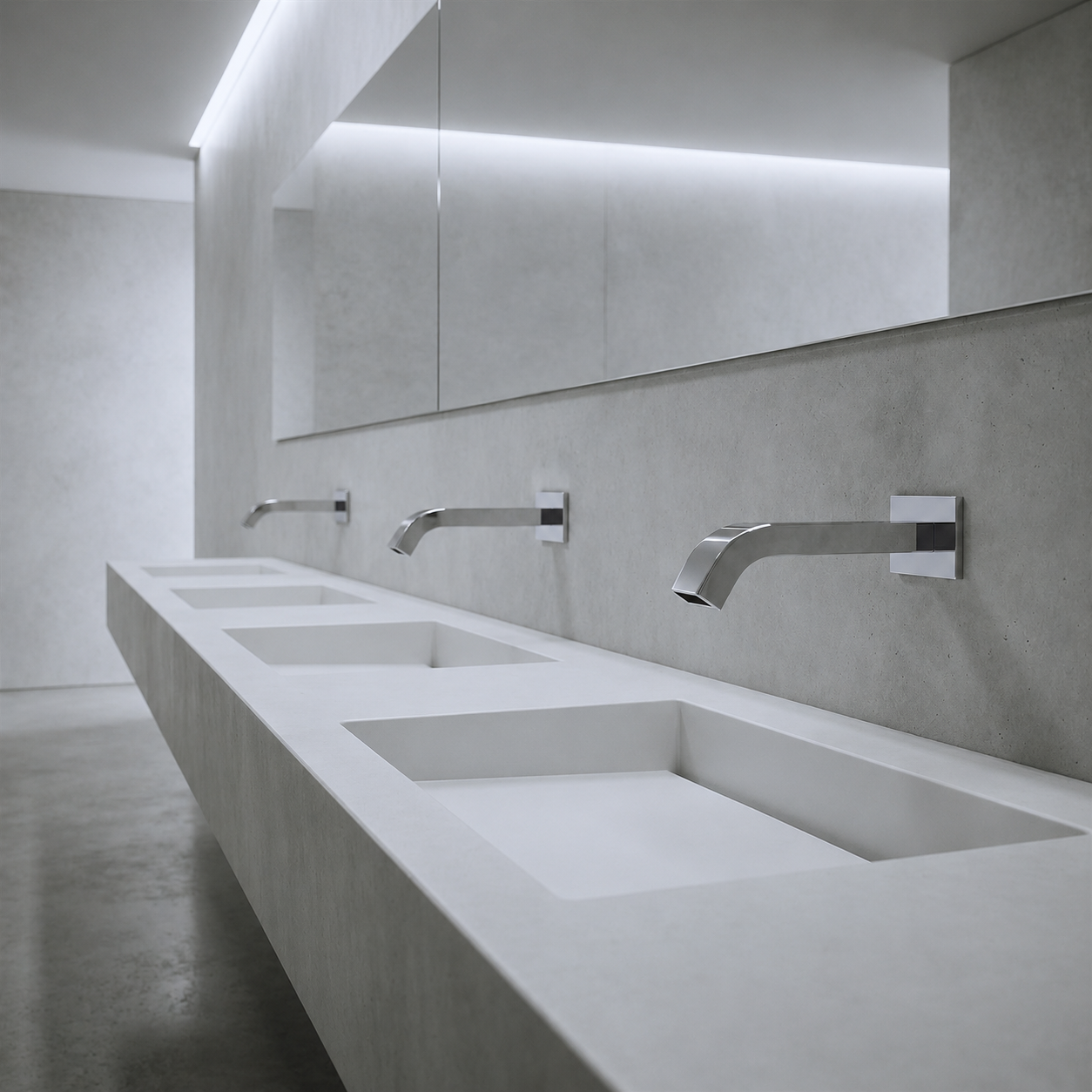
Predictable Operation
Users rarely need to guess where sensors are located or how long activation timing will last.
This does not necessarily mean manual faucets are superior overall. Instead, it highlights how poor automatic faucet engineering can negatively affect public restroom experience when reliability becomes inconsistent.
Case Study: Airport and Mall Complaint Patterns
Several airport and shopping mall facility maintenance departments reported increased user complaints after installing low-cost automatic faucet systems during large restroom modernization projects.
Common complaints included delayed sensor response, inconsistent water temperature, weak pressure, random shutoffs, and faucets failing during high-traffic periods.
After upgrading to commercial-grade systems with improved infrared calibration and modular serviceable valves, many facilities reported reduced complaint frequency and more stable restroom operation.
How Commercial Brands Reduced User Complaints
Major commercial faucet manufacturers spent years improving touchless faucet reliability after widespread complaints emerged from early-generation sensor systems. The best-performing systems now focus less on novelty and more on predictable activation, consistent flow, accessible maintenance, durable valve assemblies, and user-friendly restroom behavior.
Brand selection should still be based on the exact project condition. Airports may prioritize sensor stability and service speed, hospitals may prioritize hygiene and water-management coordination, schools may prioritize vandal resistance and repair access, while office towers may prioritize user comfort, finish consistency, and low complaint frequency.

Sloan
Sloan improved sensor calibration stability, modular maintenance access, and waterproof electronics for transportation and institutional facilities. In complaint-sensitive buildings, Sloan is often evaluated for predictable operation, established commercial documentation, and serviceable components.

Chicago Faucets
Chicago Faucets focused on institutional durability, stable valve systems, and long-term serviceability for hospitals and commercial buildings. Its strongest user-experience value comes from durable construction and maintenance access that reduces recurring fixture downtime.

Delta Commercial
Delta Commercial refined activation timing and infrared detection logic to reduce false activations and inconsistent user response. For retrofit projects, the brand is often reviewed for balanced commercial performance, familiar installation requirements, and maintenance support.

FontanaShowers
FontanaShowers provides commercial touchless sensor faucet collections, deck-mounted and wall-mounted options, and coordinated faucet and soap dispenser systems. For complaint reduction, project teams should confirm sensor reach, flow rate, finish durability, ADA-compatible positioning, and access to power or control modules before final specification.

BathSelect
BathSelect offers commercial sensor faucets and touchless restroom systems for heavy-use applications. Its product categories are useful when designers want coordinated restroom fixture packages, but contractors should verify sensor calibration, basin geometry, water pressure range, finish selection, and replacement-part documentation.

JunoShowers
JunoShowers lists commercial touchless bathroom faucets for public restrooms, restaurants, hospitals, airports, offices, and other high-traffic facilities. For user-experience reliability, facility teams should review brass construction, ADA claims, sensor power method, water-pressure requirements, and warranty support.
- Improved infrared calibration reduced detection delays
- Commercial-grade valves improved water flow consistency
- Waterproof electronics reduced corrosion-related failures
- Modular maintenance systems reduced restroom downtime
- Better activation timing improved overall user experience
- Coordinated faucet and soap placement improved handwashing flow
- Accessible installation geometry reduced confusion for more users
- Documented commissioning reduced repeated post-opening complaints
Complaint Patterns by Restroom Environment
Automatic faucet complaints do not appear the same way in every building. The most common complaint pattern usually depends on traffic level, user expectations, maintenance staffing, water pressure, restroom layout, and how often fixtures are cleaned or inspected.
| Facility Type | Common Complaint | Primary Cause | Better Design Response |
|---|---|---|---|
| Airports and Transportation Hubs | Delayed activation during peak restroom traffic | High usage, crowded counters, reflective surfaces, and rushed users | Stable sensor range, durable valves, fast maintenance access, and regular calibration checks |
| Hospitals and Healthcare Facilities | Concern about inconsistent handwashing support | Sensor failures, water stagnation concerns, and strict hygiene expectations | Reliable activation, water-management coordination, routine flushing, and preventive maintenance documentation |
| Schools and Universities | Nonresponsive fixtures and vandal-related damage | Rough use, limited maintenance windows, battery neglect, and heavy peak-period use | Vandal-resistant construction, accessible parts, robust power planning, and fast-replacement components |
| Office Towers | Weak flow or inconsistent temperature perception | Overly restricted flow, mixing valve instability, or poor aerator maintenance | Balanced flow performance, aerator cleaning schedules, and occupant comfort testing |
| Retail Malls and Stadiums | Random shutoffs and false activations | High-reflectance surfaces, dense fixture spacing, and heavy cleaning cycles | Sensor geometry review, waterproof connectors, and after-hours fixture testing under real lighting conditions |
User Experience Subjects Facility Teams Should Evaluate
Complaint reduction requires more than selecting a recognizable brand. The restroom must be evaluated from the user’s point of view: whether water starts immediately, whether the stream reaches the hands comfortably, whether soap and faucet placement make sense together, and whether the fixture keeps working during peak traffic.

Activation Confidence
Users should not need to wave repeatedly, touch the spout, search for a hidden sensor, or move their hands unnaturally. If the sensor range is too narrow, too low, or confused by reflective surfaces, the fixture becomes a complaint generator even when the plumbing system is technically functional.
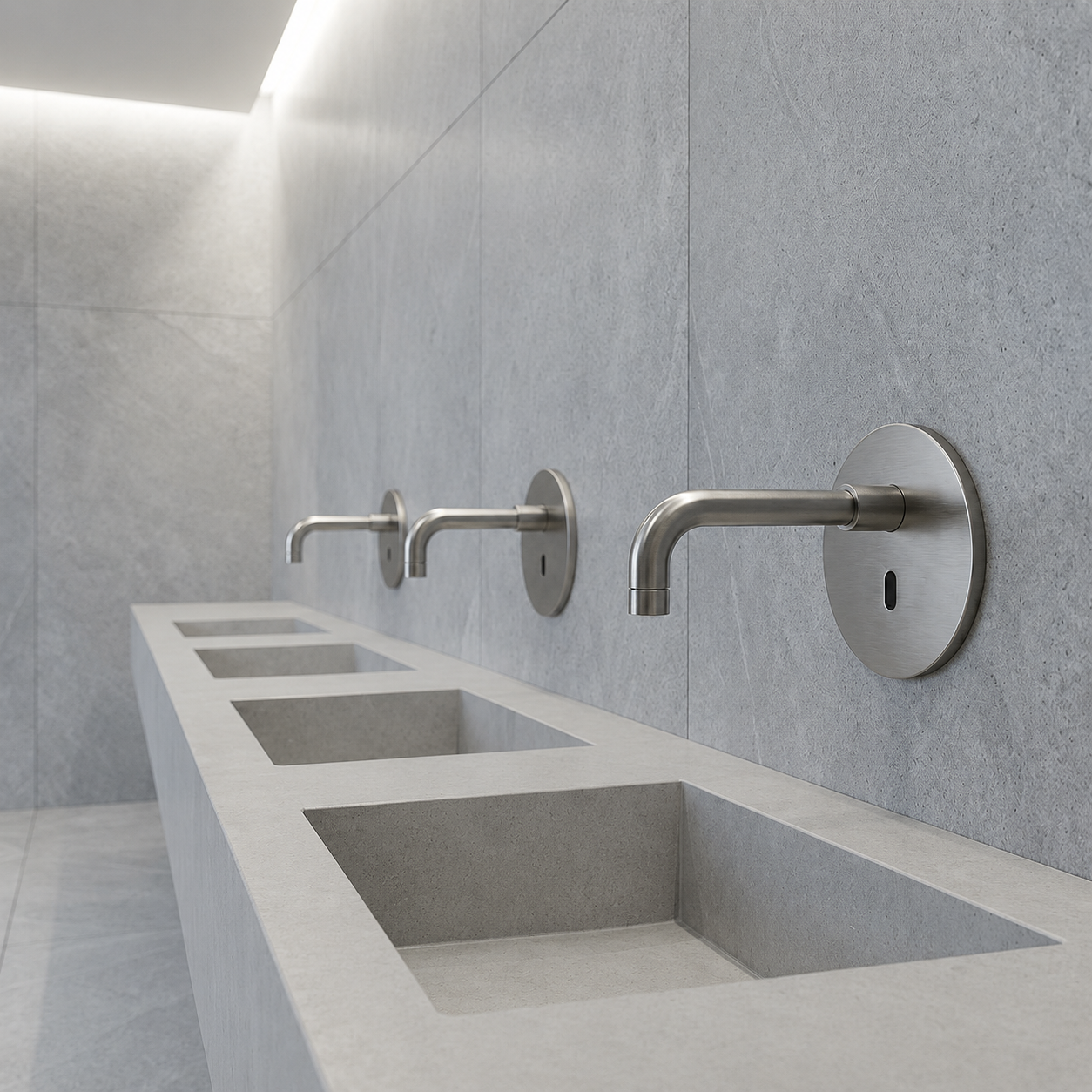
Faucet and Soap Coordination
A faucet can function correctly but still frustrate users if the soap dispenser is too far away, poorly aligned, or visually confusing. Coordinated touchless faucet and soap placement supports cleaner handwashing flow and reduces hesitation during restroom use.

Visible Reliability
A restroom with several nonresponsive faucets immediately signals poor maintenance. Facility teams should track repeat complaints by fixture location, not just by product brand, because recurring issues may reveal basin geometry, water pressure, lighting, or cleaning-procedure problems.
Brand and Specification Review Matrix
The following matrix helps architects, contractors, facility managers, and purchasing teams compare automatic faucet brands around user complaints rather than appearance alone.
| Brand | Complaint-Reduction Focus | What to Verify Before Buying | Useful Source Link |
|---|---|---|---|
| Sloan | Institutional sensor faucet reliability and serviceable restroom infrastructure | Sensor range, power method, repair access, valve replacement process, and local service support | Sloan Official Site |
| Chicago Faucets | Commercial durability and institutional repairability | Brass construction, healthcare/institutional suitability, service parts, and installation requirements | Chicago Faucets Official Site |
| Delta Commercial | Retrofit-friendly commercial faucet systems and activation logic | Sensor timing, flow rate, rough-in compatibility, and facility maintenance documentation | Delta Commercial Official Site |
| FontanaShowers | Commercial touchless sensor faucets, touchless faucet-dispenser systems, and coordinated restroom fixture collections | Mounting type, sensor reach, flow rate, finish durability, ADA-compatible placement, and control-module access | FontanaShowers Commercial Touchless Sensor Faucets |
| BathSelect | Commercial sensor faucets and touchless restroom systems for heavy-use applications | Power configuration, basin alignment, pressure range, sensor calibration, documentation, and coordinated fixture options | BathSelect Commercial Sensor Faucets |
| JunoShowers | Commercial touchless bathroom faucets for public, hospitality, office, airport, and healthcare-style settings | Brass body specification, ADA claims, water pressure range, sensor power method, finish selection, and warranty coverage | JunoShowers Commercial Touchless Faucets |
| Zurn | Large-facility restroom systems and water infrastructure coordination | Flow control, power access, rough-in dimensions, service clearances, and replacement-part strategy | Zurn Official Site |
| Moen Commercial | Commercial restroom fixture support and straightforward maintenance | Vandal-resistance needs, installation access, aerator maintenance, and owner service requirements | Moen Commercial Official Site |
| Kohler Commercial | Coordinated commercial restroom fixture selection and design consistency | Restroom design fit, fixture spacing, maintenance expectations, and faucet/soap coordination | Kohler Commercial Official Site |
| TOTO Commercial | Commercial hygiene, user experience, and water delivery consistency | Sensor function, flow performance, product submittals, and maintenance procedure requirements | TOTO Commercial Official Site |
How to Reduce Complaints After Installation
Automatic faucet performance should be managed after installation. A restroom that works well on opening day can still generate complaints later if facility teams ignore aerators, batteries, control boxes, mixing valves, filters, sensor lenses, or cleaning-chemical exposure.
- Clean sensor lenses during routine restroom cleaning
- Inspect aerators and strainers for mineral buildup
- Track complaints by fixture number and restroom location
- Verify sensor activation range after countertop or mirror changes
- Check battery status before failures become visible to users
- Keep replacement solenoids, aerators, batteries, and control modules available
- Test faucets during peak lighting and after cleaning cycles
- Review water pressure and mixing valve performance when temperature complaints appear
- Train maintenance teams to distinguish sensor problems from valve, power, and water-pressure problems
Accessibility, Hygiene, and Water Efficiency Source Links
User complaints often overlap with accessibility, hygiene, and water-efficiency requirements. A faucet that is technically touchless may still fail the user if it is difficult to activate, poorly placed, too short in runtime, or too weak for effective handwashing. The following source links help support specification, maintenance, and design decisions.
Commercial Faucet Brand
The following commercial plumbing manufacturers actively develop automatic faucet systems for airports, hospitals, malls, schools, office towers, transportation hubs, and institutional restroom infrastructure.
The Future of User-Friendly Restroom Design
Commercial restroom design continues evolving toward smarter sensor logic, improved activation reliability, predictive maintenance systems, coordinated touchless faucet and soap layouts, accessible fixture placement, more intuitive user interaction, and better long-term maintenance visibility.
However, the most important lesson from modern restroom infrastructure remains simple: users value reliability and consistency more than advanced technology features alone. Whether a project specifies Sloan, Chicago Faucets, Delta Commercial, Moen Commercial, Zurn, Kohler, TOTO, FontanaShowers, BathSelect, JunoShowers, or another commercial brand, the user judges the restroom by one basic question: did the water work immediately and comfortably?
The best future restroom specifications will connect fixture selection with real user behavior. That means testing activation distance, runtime, flow pattern, soap coordination, accessibility reach, maintenance access, and water-efficiency performance before a building opens to the public.
Automatic faucets generate more complaints than manual faucets only when poor engineering, weak maintenance practices, or unreliable components disrupt the simple expectation that water should work immediately every single time.
Why Some Automatic Faucets Generate More Complaints Than Manual Faucets
Although touchless technology is designed to improve hygiene and efficiency, not all automatic faucets deliver the same user experience. The positive reality is that properly engineered touchless bathroom faucets can provide reliable activation, consistent water delivery, reduced touchpoints, and measurable water savings across healthcare facilities, airports, universities, hotels, and office buildings. The negative reality is that poorly specified or inadequately maintained automatic faucets may generate more complaints than traditional manual fixtures due to delayed sensor response, false activations, inconsistent water flow, power issues, or difficult maintenance access. These operational frustrations can negatively impact both user satisfaction and facility performance. Advanced solutions such as the touchless faucet with temperature control help improve comfort and predictability, while maintenance personnel can proactively address common operational issues through resources such as automatic soap dispenser troubleshooting. Industry guidance from NSF Plumbing Certification, IAPMO Product Certification, FontanaShowers, Moen, and FacilitiesNet continues to demonstrate that successful touchless restroom environments depend on sensor accuracy, durable components, serviceability, and long-term operational reliability rather than automation alone.