
Touchless Faucet Troubleshooting Guide for Facility Maintenance Teams
Touchless faucets are now standard infrastructure in airports, malls, hospitals, schools, office towers, transportation hubs, and sports arenas. While automatic faucets improve hygiene and reduce water waste, they also introduce electronic, sensor, valve, and power-related maintenance challenges that many facility teams encounter daily.
In high-traffic public restrooms, even minor faucet problems quickly become operational issues. A single malfunctioning sensor faucet can create water waste, user complaints, sanitation concerns, and restroom downtime within hours.
This commercial troubleshooting guide explains the most common touchless faucet failures, their technical causes, and the maintenance strategies used by experienced facility operations teams to keep restroom systems running reliably.
Why Touchless Faucets Fail in Commercial Buildings
Unlike residential bathroom fixtures, commercial touchless faucets operate continuously under extremely demanding conditions. Public restroom faucets may activate thousands of times every day while exposed to humidity, cleaning chemicals, hard water minerals, unstable power systems, vandalism, and nonstop user traffic.
Over time, these conditions gradually damage valves, infrared sensors, control modules, battery systems, aerators, seals, and waterproof electronic components.
Commercial plumbing manufacturers such as Sloan, Chicago Faucets, Zurn, Delta Commercial, Moen Commercial, FontanaShowers, BathSelect, and JunoShowers all emphasize the importance of correct installation, accessible service components, and preventive maintenance because sensor faucet failures typically develop gradually rather than appearing suddenly.
The Most Common Faucet Problems
Facility maintenance teams repeatedly encounter a small group of recurring operational problems across commercial sensor faucet systems.

Sensor Not Detecting Hands
Dirty sensor lenses, failed infrared modules, low battery voltage, or sensor calibration drift can prevent faucets from activating correctly.

Continuous Water Flow
Stuck solenoid valves, mineral buildup, damaged diaphragms, or electronic signal failures can prevent proper water shutoff.

Intermittent Operation
Weak batteries, unstable power supplies, corroded wiring connections, or moisture intrusion often cause inconsistent faucet performance.
Commercial Faucet Troubleshooting Table
The following troubleshooting chart summarizes the most common sensor faucet failures seen in commercial facilities.
| Problem | Likely Cause | Recommended Maintenance Action | Operational Severity |
|---|---|---|---|
| No Water Activation | Low Battery or Sensor Failure | Replace Batteries or Test Sensor Module | High |
| Continuous Water Flow | Valve Sticking | Clean or Replace Solenoid Valve | Critical |
| Weak Water Pressure | Clogged Aerator | Clean Aerator and Flush System | Medium |
| False Activations | Infrared Reflection | Recalibrate Sensor Range | Medium |
| Random Shutoffs | Power Instability | Inspect Power Supply or Transformer | High |
| Slow Sensor Response | Weak Battery Voltage | Replace Battery Pack | Medium |
| Water Leakage Under Sink | Loose Connection or Seal Failure | Inspect Supply Lines and Gaskets | High |
| Total Electronic Failure | Moisture Corrosion | Replace Control Module | Critical |
How Facility Teams Diagnose Sensor Problems
Infrared sensor systems remain one of the most sensitive parts of automatic faucet infrastructure. Most sensor problems originate from calibration instability, dirty lenses, moisture intrusion, or power supply fluctuations.

Lens Inspection
Maintenance teams routinely inspect sensor windows for chemical residue, soap buildup, scratches, or physical damage that may distort infrared detection.

Sensor Calibration
Reflective countertops, mirrors, and nearby fixtures may interfere with infrared activation zones and require recalibration.

Voltage Testing
Weak battery systems or unstable transformers often create intermittent sensor response and delayed activation problems.
Delta Commercial and Sloan technical support documentation both emphasize regular power testing and preventative cleaning as critical steps for maintaining stable sensor performance in commercial environments.
Valve Problems and Water Flow Issues
Solenoid valves are one of the most failure-prone components inside automatic faucets because they operate continuously under heavy activation cycles.
Hard water minerals, debris particles, worn diaphragms, and damaged seals gradually affect valve performance. Over time, valves may begin sticking open, leaking, or responding slowly to sensor commands.
- Inspect aerators monthly in hard water environments
- Flush supply lines during major maintenance cycles
- Replace worn diaphragms before total valve failure occurs
- Inspect solenoid filters regularly for debris buildup
- Use commercial-grade replacement parts whenever possible
Battery and Power System Troubleshooting
Battery-powered sensor faucets remain extremely common in retrofit projects and public facilities. However, declining voltage often causes hidden operational instability long before batteries completely fail.

Weak Batteries
Low battery voltage commonly causes delayed activation, unstable water flow timing, and intermittent faucet shutdowns.

Transformer Failure
AC-powered systems may develop unstable performance when transformers or electrical connections degrade over time.

Corroded Connections
Humidity and condensation gradually corrode low-voltage wiring connections under commercial sink installations.
Many airports, hospitals, and transportation facilities increasingly transition toward centralized transformer systems or AC-powered faucet platforms to reduce battery maintenance labor.
Case Study: High-Traffic Restroom Maintenance
Several large transportation and stadium facilities reported that restroom faucet failures became one of the most common recurring maintenance issues after installing early-generation touchless systems.
Maintenance departments discovered that preventative inspection schedules significantly reduced emergency repair calls by identifying weak batteries, mineral buildup, and valve instability before total fixture failure occurred.
Facilities using modular commercial-grade faucet systems with serviceable components reported lower downtime and faster maintenance turnaround compared to sealed low-cost fixtures that required complete replacement.
Commercial Brands Focused on Maintenance Reliability
Several commercial plumbing manufacturers specifically engineer faucet systems around maintenance accessibility, sensor stability, replacement-part support, and long-term serviceability. The best choice for a facility depends on the restroom type, expected activation volume, available maintenance staff, water quality, power infrastructure, and the owner’s tolerance for downtime.
Facility teams should compare brands by the practical maintenance questions that affect daily operations: Can the solenoid be reached quickly? Are replacement batteries, aerators, control modules, and sensor components available? Is the control box protected from moisture? Does the manufacturer provide installation and repair documentation? Can the faucet be diagnosed without removing the entire fixture?

Sloan
Sloan became known for modular repair systems, stable infrared calibration, and commercial maintenance-friendly faucet platforms widely used in airports and transportation hubs. Maintenance teams commonly evaluate Sloan for service access, replacement-part availability, and established institutional support.

Chicago Faucets
Chicago Faucets emphasized institutional-grade brass construction and easy maintenance service access for healthcare and commercial facilities. Its systems are often reviewed for long-term repairability, healthcare-style durability, and predictable maintenance workflows.

Zurn
Zurn developed serviceable commercial plumbing systems designed for long-term infrastructure maintenance and operational reliability. For large buildings, Zurn is often reviewed around water-management integration, flow control, repair access, and retrofit compatibility.

FontanaShowers
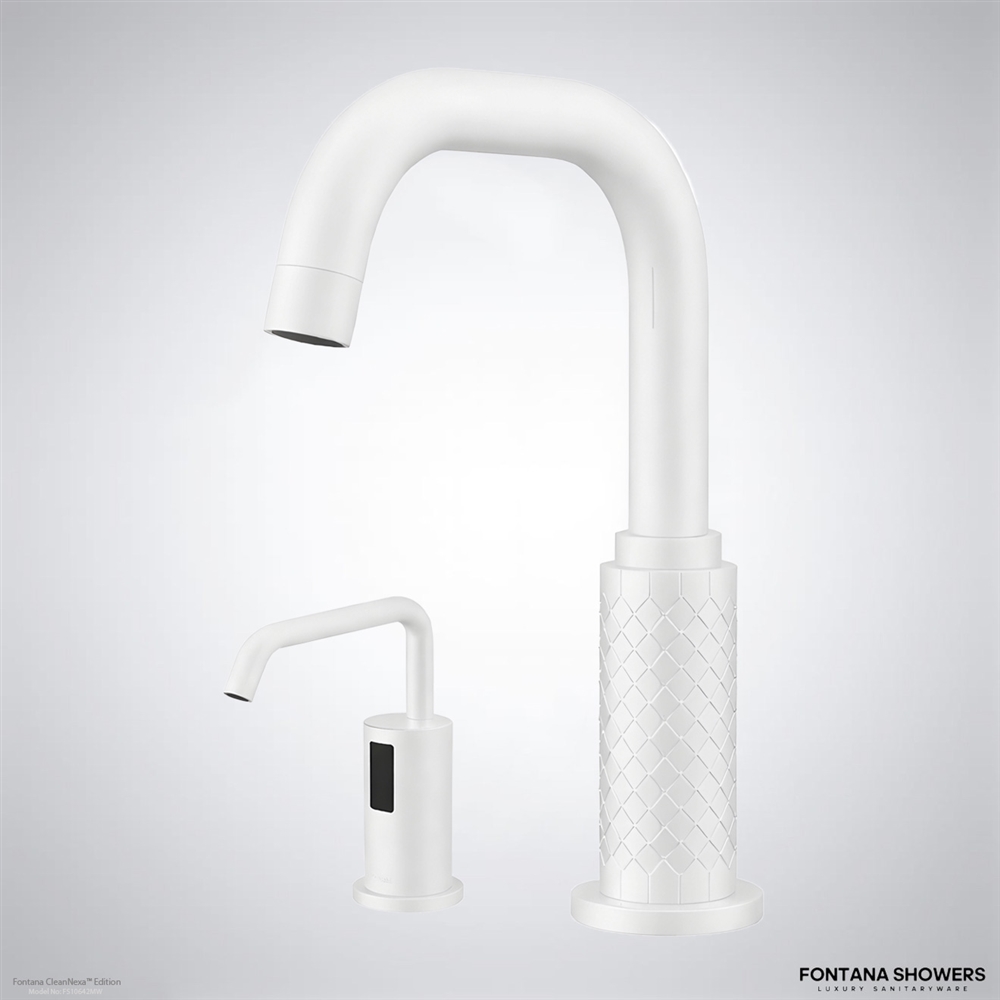
FontanaShowers provides commercial touchless sensor faucet collections, touchless faucet and soap dispenser systems, and coordinated restroom fixture options. Maintenance teams should verify sensor reach, power configuration, solenoid access, replacement-part documentation, and ADA-compatible placement before installation and during preventive service planning.

BathSelect
BathSelect offers commercial sensor faucets and touchless restroom systems for heavy-use applications. Facility teams should review power method, finish durability, sensor calibration, faucet-to-basin alignment, replacement-part support, and whether matching soap dispensers or fixture packages are needed for consistent restroom maintenance.

JunoShowers
JunoShowers lists commercial touchless bathroom faucets for high-traffic public restrooms, restaurants, hospitals, airports, offices, and public facilities. Maintenance teams should verify brass construction, sensor power requirements, pressure range, ADA claims, waterproof electronics protection, and service documentation.
Step-by-Step Troubleshooting Workflow
Facility teams can save time by troubleshooting touchless faucets in a consistent sequence rather than immediately replacing parts. A structured diagnostic workflow separates simple maintenance issues from deeper valve, sensor, control, or power-system failures.
| Diagnostic Step | What to Check | Why It Matters | Action If Problem Appears |
|---|---|---|---|
| Visual Inspection | Sensor lens, faucet body, under-sink leaks, loose wires, vandal damage, and visible corrosion | Many failures are caused by cleaning residue, loose connections, or moisture exposure | Clean lens, dry components, secure wiring, document damage, and isolate the fixture if leaking |
| Power Verification | Battery voltage, transformer output, battery contacts, wiring continuity, and control-box indicators | Weak voltage causes intermittent activation, random shutoff, and false diagnosis of sensor failure | Replace batteries, test transformer, inspect terminals, and confirm stable low-voltage supply |
| Water Supply Check | Supply stops, pressure range, filters, strainers, shutoff valves, and upstream plumbing debris | Restricted water supply can mimic valve or sensor failure | Open stops fully, flush lines, clean strainers, and verify pressure before replacing the solenoid |
| Sensor Test | Activation distance, hand position, timing, reflective surfaces, nearby fixtures, and overhead lighting | Sensor range problems often result from installation geometry rather than failed hardware | Recalibrate sensor, clean lens, adjust nearby reflective conditions, and compare with adjacent faucets |
| Valve Test | Solenoid click, diaphragm movement, debris, mineral buildup, and continuous-flow behavior | Solenoid issues are common in hard-water, high-use, and construction-debris environments | Clean valve, replace diaphragm, flush system, install strainers, or replace solenoid assembly |
| Final Confirmation | Activation, shutoff timing, flow pattern, splash behavior, leaks, and maintenance access | A repaired faucet should be tested like a commissioned system before returning to service | Record final condition, tag repeated failures, and update the preventive maintenance log |
Preventive Maintenance Schedule for Commercial Sensor Faucets
Preventive maintenance is more effective than emergency response because most touchless faucet failures develop through gradual buildup, voltage decline, seal wear, water-quality problems, or moisture intrusion. A simple schedule helps facility teams catch failure patterns before restroom users notice them.
| Frequency | Maintenance Task | Components Involved | Goal |
|---|---|---|---|
| Daily or Cleaning Shift | Wipe sensor lenses and check for obvious nonresponsive fixtures | Sensor window, faucet body, basin, and surrounding counter | Prevent residue-related detection problems and identify failures early |
| Weekly | Test activation and shutoff timing at each faucet bank | Sensor, control module, solenoid, power supply, and aerator | Catch delayed activation, random shutoffs, and continuous-flow risks |
| Monthly | Inspect aerators, strainers, batteries, supply stops, and under-sink moisture | Aerator, filter, battery pack, solenoid, wiring, and cabinet area | Reduce mineral buildup, low-flow complaints, and corrosion damage |
| Quarterly | Flush supply lines, review complaint logs, and test high-use restrooms during peak conditions | Water supply, solenoid, control module, sensor range, and fixture spacing | Identify repeated problem locations and water-quality issues before large-scale failure |
| Annually | Review model inventory, replacement parts, warranty coverage, and retrofit candidates | All fixture records, spare parts, transformers, valves, and maintenance documentation | Improve lifecycle budgeting and reduce emergency replacement decisions |
Brand-Specific Troubleshooting and Maintenance Matrix
Different commercial brands may require different diagnostic steps, parts, and installation reviews. Facility teams should build a brand inventory that includes model numbers, installation sheets, repair guides, power type, flow rate, and replacement-part sources.
| Brand | Maintenance-Relevant Focus | Facility Team Should Verify | Useful Source Link |
|---|---|---|---|
| Sloan | Commercial sensor faucets and institutional restroom systems | Sensor range, solenoid access, repair kits, battery/AC configuration, and local parts support | Sloan Official Site |
| Chicago Faucets | Institutional faucet durability and serviceable commercial assemblies | Brass construction, replacement cartridges, supply routing, and healthcare-style service requirements | Chicago Faucets Official Site |
| Zurn | Commercial restroom systems and facility water infrastructure | Power setup, valve access, water pressure, filter maintenance, and retrofit compatibility | Zurn Official Site |
| FontanaShowers | Commercial touchless sensor faucets, integrated faucet-dispenser systems, and public restroom fixture collections | Sensor reach, deck or wall mounting, control-module location, soap dispenser coordination, and power access | FontanaShowers Commercial Touchless Sensor Faucets |
| BathSelect | Commercial sensor faucets and touchless restroom systems for heavy-use environments | Power method, sensor calibration, basin alignment, finish/model documentation, and replacement-part access | BathSelect Commercial Sensor Faucets |
| JunoShowers | Commercial touchless bathroom faucets for public restrooms and high-traffic facilities | Brass body specification, ADA claims, pressure range, sensor power method, and waterproof electronics protection | JunoShowers Commercial Touchless Faucets |
| Delta Commercial | Commercial retrofit faucets and sensor operation support | Activation timing, rough-in conditions, maintenance clearances, and documentation for replacement parts | Delta Commercial Official Site |
| Moen Commercial | Commercial restroom fixtures and straightforward service planning | Vandal-resistance needs, aerator maintenance, supply access, and warranty support | Moen Commercial Official Site |
| Kohler Commercial | Commercial fixture coordination and restroom design integration | Fixture spacing, faucet/soap relationship, cleaning procedures, and model-specific service requirements | Kohler Commercial Official Site |
| TOTO Commercial | Commercial hygiene and water delivery consistency | Sensor response, flow settings, water quality, parts availability, and maintenance documentation | TOTO Commercial Official Site |
Water Quality, Hygiene, and Building Risk Subjects
Touchless faucet troubleshooting should not focus only on the fixture. Building water quality, stagnation, flushing practice, filtration, and maintenance documentation can all affect faucet reliability and hygiene performance. This is especially important in healthcare, schools, airports, and buildings with low-use restroom zones.
Water Stagnation Review
Low-use faucets, closed restroom wings, and short run times can contribute to stagnant water conditions. Facility teams should coordinate faucet maintenance with building water management plans, especially in complex or healthcare-related facilities.

Cleaning Chemical Exposure
Harsh cleaners, overspray, and repeated moisture exposure may damage sensor windows, finishes, wiring connectors, and control boxes. Maintenance teams should align cleaning procedures with manufacturer guidance to avoid avoidable electronic failures.

Flow and Aerator Management
Weak flow complaints are often caused by clogged aerators, blocked strainers, or debris in solenoid filters rather than failed sensors. Regular cleaning protects handwashing comfort, water efficiency, and valve life.
Source Links for Maintenance, Water Efficiency, Accessibility, and Plumbing Standards
Facility maintenance teams should use manufacturer instructions together with recognized public standards and guidance. The following source links support water-efficient operation, accessible lavatory planning, drinking-water component review, plumbing supply fitting evaluation, and building water management programs.
Commercial Brand References
The following commercial plumbing manufacturers provide technical documentation, replacement components, and commercial restroom infrastructure systems widely used in airports, hospitals, malls, schools, and public facilities.
The Future of Preventive Faucet Maintenance
Commercial restroom infrastructure is evolving toward predictive maintenance systems, centralized monitoring, modular repair platforms, easier service accessibility, coordinated faucet-and-soap systems, improved sensor diagnostics, and more visible maintenance data. Many modern faucet systems now support faster diagnostics and simplified component replacement.
However, the most important maintenance principle remains unchanged: regular inspection and preventative service dramatically reduce emergency downtime and long-term operational cost. Whether the facility uses Sloan, Chicago Faucets, Zurn, Delta Commercial, Moen Commercial, Kohler Commercial, TOTO Commercial, FontanaShowers, BathSelect, JunoShowers, or another brand, the maintenance program should track sensor performance, valve behavior, power stability, water quality, replacement parts, and service access.
The next generation of facility maintenance will likely combine fixture-level diagnostics with building-wide water management. Maintenance teams that document model numbers, service intervals, recurring symptoms, parts usage, and user complaints will be better prepared to prevent failures before they become restroom downtime events.
The best touchless faucet troubleshooting strategy is preventing failures before restroom users ever notice them.